Body of Work
Over the course of my practice, I have found that the work I do best is shaped by a consistent set of values: a commitment to accessibility and usability as non-negotiables, a belief that technology is most powerful when it serves a clear and human narrative, and a preference for projects that have real stakes for the learners at the centre of the work. These values are not incidental to the work. They are the methodology.
Featured Projects
These case studies tell the story of three distinct challenges faced by three very different clients. Each project demanded a unique combination of skills and a fresh approach to achieve a successful outcome. I invite you to select a project below to explore the work in depth.
jobs created in Atlantic Canada following the pivot to virtual startup programming, providing a ready-built safety net when COVID arrived.
The challenge
Atlantic Canada's geography left rural entrepreneurs cut off from Propel's face-to-face programs. Moving all programming online meant rebuilding from the ground up and helping a coaching team reimagine how they worked.
My role
Sole learning strategist and designer. Led needs analysis, LMS selection, curriculum development for two flagship programs, and created a learner experience map to align coaches and the C-suite.
The outcome
Two core programs launched on schedule with strong uptake. The relationship with Propel has continued to grow, with new programming, platforms, and engagement options rolling out as the virtual accelerator evolves.
Propel's Virtual Tech Accelerator
Propel · Atlantic Canada · ↻ Ongoing
1,400+
Jobs created in Atlantic Canada
1st
Virtual startup tech accelerator in Atlantic Canada
7+
Years of ongoing collaboration
The challenge
Propel is a private sector-led, not-for-profit startup tech accelerator that helps emerging companies bring technology-based ideas to market across Atlantic Canada. With major centres spread far apart and many entrepreneurs living in rural areas, Propel's face-to-face delivery model was leaving a significant portion of its audience unreached.
The move to online delivery was not simply a question of digitising existing content. It required selecting and standing up a new LMS, and it required the coaching team to fundamentally reimagine how their face-to-face practice would translate to an online environment. Understanding the fears, hopes, and technical literacy of that team was central to making the transition work.
My role
I was engaged as sole learning strategist and designer, working directly with Propel staff, coaches, and the COO. The work spanned strategy through to delivery across two flagship programs.
A key design decision was injecting the coaches' voices into the online modules directly, creating a coherent experience that built trust with founders and preserved the relational quality of the original face-to-face model.
- Needs analysis with coaches and staff
- LMS testing and selection
- eLearning curriculum development for two flagship programs
- Learner experience (LX) map for C-suite and coaching team alignment
- Direction and curation of expert speaker content
- Design and development of program courses and micro-courses
The outcome
Both programs launched on schedule and were positively received by the startup community. The pivot to virtual delivery resulted in increased demand for Propel programming, an expansion of startup services, and broader reach across Atlantic Canada.
When COVID shut down all in-person startup support across the region, Propel was already operating fully online. As the first out of the gate with virtual entrepreneurial programming in Atlantic Canada, Propel became a resource for other regional accelerators and incubators navigating the same transition.
The virtual tech accelerator model continues to evolve. The ongoing relationship has expanded to include new platforms, micro-courses, and engagement formats as Propel's programming grows.
Work samples
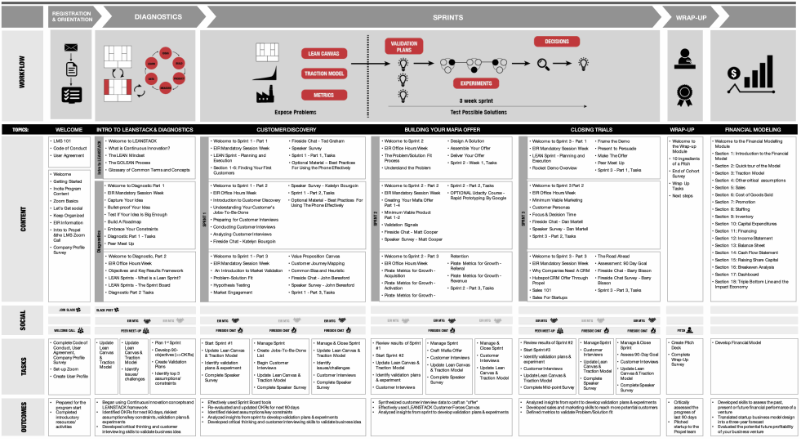

from project kickoff to a fully functional interactive ebook, delivered on schedule and enthusiastically received by the paramedicine faculty.
The challenge
An NRC-funded initiative paired a graduating class of Video Game Art and Animation students with Holland College's Advanced Care Paramedicine program. The team had to learn a new medium, with new tools, under an extremely tight timeline.
My role
Instructional oversight and project management of the student production team. Embedded on-site for the duration, working alongside paramedicine instructors as subject matter experts and the Director of Applied Research as key stakeholder.
The outcome
A fully functional interactive ebook guiding paramedicine students through the fundamentals of airway management, featuring 3D anatomical models, animated intubation procedures, and instructor-led video. The student team went from novice to production-ready in six weeks.
Advanced Care Paramedicine eBook
Holland College · Prince Edward Island · Medical Education · Higher Education
6 wks
From kickoff to delivered product
NRC
National Research Council of Canada funded initiative
3D
Anatomical models and animated procedures built by a student team
The challenge
A National Research Council of Canada (NRC) initiative brought together two programs at Holland College in Prince Edward Island: a graduating class from the Video Game Art and Animation program, and the instructors of the Advanced Care Paramedicine program. The goal was to give graduating students real-world project experience while addressing a genuine knowledge gap for paramedicine learners.
The original brief called for a video game. Early conversations with the paramedicine instructors made clear that the most valuable thing the team could create was something quite different: a resource that could tackle the most conceptually challenging topics in the curriculum, particularly intubation and airway management, in a way no textbook could.
The constraints were significant. The team was newly formed, the timeline was six weeks, and the students were working with tools and a medium entirely outside their training.
My role
I was brought in to provide instructional oversight and project management, embedded on-site for the full duration. As a former video game producer, I was well placed to expose the student team to the kinds of project processes and production demands they would encounter in industry.
The project was managed using an agile methodology, with iterative design and development cycles, incremental asset reviews by the paramedicine stakeholders, and daily scrums to maintain production rhythm and accountability.
- Needs analysis with paramedicine instructors and the Director of Applied Research
- Project scoping and pivot from video game brief to interactive ebook
- Team leadership and day-to-day production management
- Agile sprint planning and daily scrums
- Instructional design oversight across all content and interactions
- Stakeholder reviews and iterative feedback loops with paramedicine faculty
The outcome
The team delivered an interactive ebook guiding paramedicine students through the fundamentals of airway management. The ebook featured detailed 3D models of throat and nasal anatomy, animated procedures for rescue and intubation, and in-depth instructional videos from the program's faculty.
The paramedicine instructors enthusiastically accepted the final product. The project also demonstrated that digital design and production skills are highly transferable across industries, a point of recognition that resonated strongly with the college.
For the student team, the project was a formative professional experience. One team member, inspired by the project management process, went on to build a very successful career as a PM.
Work samples


contract with the Government of Prince Edward Island secured directly as a result of this prototype, built end-to-end by a one-person team.
The challenge
Early childhood research in Canada was happening in silos, rarely reaching the practitioners and policymakers who needed it most. UPEI and the PEI Children's Secretariat wanted a prototype online commons that could address this locally and potentially scale nationally.
My role
Sole designer and developer, embedded within the research department at UPEI. Responsible for the full lifecycle: stakeholder consultation, information architecture, design and development, custom illustration, testing, and stakeholder training.
The outcome
A fully functional knowledge portal built on Drupal, featuring personalised content for different stakeholder audiences. The prototype impressed the principal investigators and government partners, and led directly to a new contract with the Government of PEI.
PEI Child Knowledge Translation Portal
UPEI · Government of Prince Edward Island · Higher Education · Government
Solo
End-to-end delivery: strategy, design, development, illustration, training, and QA
2
Partner organisations: UPEI research team and the PEI Children's Secretariat
Gov't
New contract with the Government of PEI secured as a direct result
The challenge
Early childhood research in Canada was largely happening in academic silos. The work of researchers rarely made its way to the practitioners and government decision-makers who were shaping policy and investment in early years initiatives. The Research in Early Child Development (RECD) team at UPEI, in partnership with the PEI Children's Secretariat (PEI CS), wanted to change that.
The PEI CS is a group of community and government representatives working across sectors, communities, and departments as a collective voice to improve outcomes for children up to age eight. Their vision was an online commons: a central space where early childhood development researchers, practitioners, government officials, and families could find current research, engage in professional dialogue, and access tools to support their work. Critically, the project needed to serve as a proof of concept that could attract further funding and potentially scale to a national model.
My role
I joined the RECD team in July 2009 as Digital Media Technologist, embedded within the research department at UPEI as the sole designer and developer. The scope was unusually broad for a single person: I wore the hats of strategist, information architect, UX designer, front-end developer, illustrator, animator, QA tester, and trainer across the full lifecycle of the project.
A key challenge was technology selection. I identified Drupal as the right platform for the project's requirements, despite having no prior experience with it. I upskilled rapidly and used Drupal's module ecosystem to build a personalised content experience, surfacing different information to different stakeholder audiences based on user group assignment.
The portal was structured around three core pillars: Learn, Discuss, and Collaborate, which later evolved into Research, Projects, and Community as the site matured through user testing and stakeholder feedback.
- Stakeholder consultations and needs analysis with RECD and PEI Children's Secretariat
- Project planning and phased development roadmap
- Needs chart, sitemap, wireframes, and information architecture
- Technology selection, setup, and configuration
- Full portal design and development
- Custom illustration and visual asset creation
- User testing and focus groups (December 2009)
- Training delivery for PEI CS members (January and February 2010)
- Tutorial development for remote stakeholders
- Contribution to the published project monograph
The outcome
A fully functional knowledge portal was delivered, built on Drupal with MySQL and using views-based content personalisation to serve targeted information to different stakeholder groups. The portal featured a sophisticated social learning design, enabling users to engage with one another across professional networks and topic areas, including forums, blogs, group spaces, and a real-time activity feed.
The visual design was created entirely from scratch. Every illustration was hand-crafted in Adobe Illustrator to give the site a distinctly PEI character, with a polished aesthetic designed to encourage users to explore and return.
The prototype exceeded expectations. It was used as the basis for an application for further funding, and impressed the principal investigators and government partners sufficiently to generate a new, direct contract with the Government of Prince Edward Island.
The work was also formally recognised through publication in an academic research monograph, a rare outcome for a design and development project.
Published work
Duncan, E. (2010). PEI Child: A digital learning commons for early child professionals. In R. Doiron & M. Gabriel (Eds.), Research in early child development in Prince Edward Island: A research monograph (pp. 44–53). Charlottetown, PE: Centre for Education Research, University of Prince Edward Island.
Work samples